Saliva: The First Marks of Us

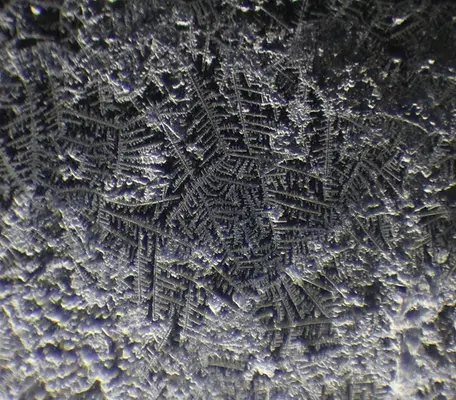
Microscopic View of dried saliva showing similar geometry to a feather
Saliva is often overlooked, yet it is one of the most personal fluids we produce. It is not just water from the mouth—it is a living library of biology. Every drop carries enzymes such as amylase and lipase, which begin breaking down food the moment we eat. Alongside enzymes, saliva contains minerals, peptides, and host proteins that reflect diet, hydration, and immune activity. It also carries the oral microbiome—hundreds of bacterial species whose composition shifts with diet, stress, and health. In the context of the Resonance Loop, saliva is one of the simplest and most profound ways we can write ourselves into the soil.
---------
Fresh saliva is alive with activity. Its enzymes continue working when offered to organic matter in a worm bin, and its microbes can seed the soil with living inoculants. In this way, fresh saliva acts as a biological spark: both catalyst and community.
---------
Dried saliva tells a different story. As saliva evaporates, salts and proteins crystallize into stable residues that preserve information even without living microbes. Forensic science has shown that dried saliva residues can be recovered and analyzed long after deposition, proving that chemical motifs remain intact. In this fossil form, saliva offers memory rather than life: microbes in the soil do not need the original cells or enzymes to survive, only the crystallized motifs they can dissolve and interpret.
---------
The salivary metabolome contains amino acids, organic acids, and microbial metabolites that change with stress, disease, or immune activation. The salivary proteome reflects inflammation and immune state, making saliva a powerful diagnostic fluid. Each individual produces a unique chemical signature—so distinctive that saliva is often referred to as a personal chemical fingerprint. For microbes, these motifs are not foreign: amino acids, peptides, and salts are substrates and signals they readily sense, transport, and metabolize in soil.
---------
Ethical and health concerns are minimal. Fresh saliva should only be offered from a healthy individual, as it carries living microbes. Dried saliva, however, is inert: its residues are chemically stable and free from living pathogens. What remains is not waste, but signal.
---------
Adding saliva to the loop is not contamination—it is communication. It is one of the most direct ways to offer the soil a reflection of ourselves. Each sample is a message, carrying echoes of our diet, our immune state, and our stress. In the loop, these echoes become legible. Worms prepare them, microbes interpret them, and plants respond in kind. Fresh saliva contributes life. Dried saliva preserves memory. Both paths are valid, and both show us that the soil is ready to listen when we speak with what we are.